Here’s the uncomfortable thing I’ve slowly come to accept: the part of my work I’m best at is the part that got cheap first.
These days I run almost everything through a model before I touch it — draft the explanation, scaffold the code, compress a forty-page report into ten lines. Most of the time what comes back is hard to fault, and it arrives faster than I could have typed the first paragraph. But there’s a category of problem it has never once solved for me, and they all share one property: the problem was never in my prompt. It was still out in the world — in a workaround someone invented to avoid the official process, in a complaint nobody wrote down.
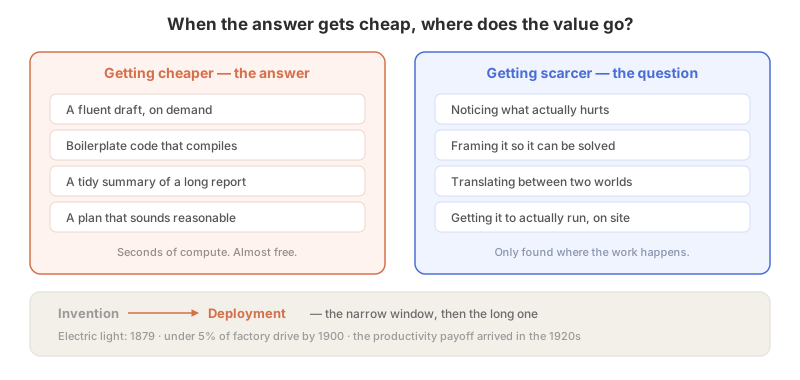
So the real question isn’t “will AI replace me.” It’s this: when the price of producing an answer collapses, where does human value actually move?
1. Answers are getting cheaper, and you can see it in the data
Stanford’s Digital Economy Lab (Brynjolfsson, Chandar, Chen) tracked ADP payroll records covering millions of US workers through June 2026. A few findings are worth copying down verbatim:
- There’s no evidence of widespread, economy-wide job displacement. This is not “the machines came and everyone lost their job.”
- But workers aged 22–25 in AI-exposed occupations show about 19% lower employment than same-age peers in less exposed work. Experienced workers in the same occupations show no comparable gap.
- The decline comes from reduced hiring, not layoffs. The door is closing slowly; nobody is being pushed through it.
- The dividing line is substitution vs. complementarity. Occupations where AI substitutes for the work show steep declines. Occupations where it complements the worker stay flat or grow.
It’s a working paper, still being revised and argued over. But it sharpens the question a lot: in my particular seat, does AI do work for me or instead of me? Those sound similar and end very differently.
Follow that logic and the answer falls out on its own. If generating the answer is what’s deflating, then whatever is still appreciating must sit upstream or downstream of it — upstream is the question, downstream is deployment.
2. The value is with whoever finds the problem
In 1964, Getzels and Csikszentmihalyi at the University of Chicago ran an experiment that people are still citing. They put 31 art students in a studio with a table of 27 objects — grapes, a steel gearshift, an old book, a glass prism — and gave each of them an hour: pick your objects, build your own arrangement, draw it.
The students split cleanly into two groups.
One group started fast: chose objects, arranged them, sketched an outline, and spent the rest of the hour refining the composition they’d committed to in the first five minutes. They were solving a problem they had already set.
The other group fooled around uncomfortably long: picking objects up, turning them over, changing arrangements, switching materials, erasing, starting over. Some spent fifty minutes exploring before racing to finish. They weren’t solving the problem. They were looking for it.
Five years later the researchers followed up on 27 of them — gallery shows, dealer representation, museum acquisitions, whether they were still making art at all. The result was blunt: the problem-finders were meaningfully more successful, and of the 11 students who were least problem-finding, 8 had left art entirely.
I like this study because it separates two things we usually blur together. Solving is one skill; seeing which problem is worth solving is another, and the second is rarer, ages better, and — new development — is much harder to hand to a model. Give an AI a well-defined problem and it will out-answer you. But defining it isn’t something it can do for you, because the raw material for the definition isn’t in the training corpus. It’s on site.
In practice that means one thing: go where the work actually happens.
- Building product? Sit in the support queue for a day and listen to people complain about your thing.
- Doing ops or admin? Just ask colleagues which process they hate most, and how they route around it.
- Running a shop? Work the register yourself for a few days.
This holds at home too. When you help a kid with homework, the “site” isn’t the notebook of wrong answers — it’s the second they stall. Did they misread the question, is the concept missing, or are they just tired? When you look after an aging parent, the site isn’t the number on the lab report; it’s whether the way they take the stairs has changed. You can outsource the answer. You can’t outsource noticing.
3. Be a translator, not a career-changer
Spend enough time on site and you hit the next wall: you can see the real problem, but you don’t know whether the new tools can touch it — or where they’ll quietly fall over.
Harvard Business School and BCG ran a field experiment with 758 consultants (Dell’Acqua et al., roughly 7% of BCG’s individual-contributor staff). The result has two halves, and most people only remember the first:
- Inside the AI’s capability frontier: consultants using AI completed 12.2% more tasks, 25.1% faster, at more than 40% higher quality. The biggest gains went to the lowest performers, who improved by 43%.
- Outside it: consultants using AI were 19 percentage points less likely to reach the correct solution than those working without it.
The authors call this boundary a jagged frontier — not a smooth line but a ragged one. Two tasks that look equally hard from the outside: the model nails one and confidently botches the other. And both outputs look exactly the same on the page.
This is precisely where a translator earns their keep. Knowing how to use AI isn’t the scarce thing. Knowing where it will fall over is — and that knowledge is made of domain expertise, not prompt tricks. An accountant doesn’t need to become a programmer, but an accountant who understands these tools can rebuild a department’s whole reconciliation process and know which two steps must never be signed off by a model. A teacher doesn’t need to train models, but a teacher who plans lessons with AI and knows exactly where it invents things is not replaceable by a colleague who doesn’t.
You don’t need to be top-tier in two fields. Being fluent enough to hold a real conversation in two fields already puts you somewhere very few people stand. For most people, grafting a layer of tool understanding onto the domain you already have beats burning it down and switching careers — it’s more realistic, and a far better return.
4. Follow deployment, not just invention
The first three are about how to work. This one is about where to stand.
Look at electrification. The light bulb was invented in 1879 and patented in 1880. By 1900, only 3% of American homes had electric lighting, and electric motors accounted for less than 5% of factory mechanical drive. The 50% threshold wasn’t crossed until the 1920s.
What happened in those forty years? Economic historian Paul David’s answer: at first, factory owners simply swapped the steam engine for a dynamo and kept everything else — the line shafting, the belts, the whole centralized drive layout. Naturally, productivity barely moved. The real turn was unit drive: an individual motor on each machine, which meant the floor could be rearranged, and buildings could be lighter, modular, single-story. And spreading that across industries and towns required, in David’s words, “building up a cadre of experienced factory architects and electrical engineers familiar with the new approach to manufacturing.”
Technology history keeps repeating this shape: the invention window is narrow and crowded with geniuses; the deployment window is far wider, stays open much longer, and is much friendlier to ordinary people. Electrical engineers in the electric era, web shops and sysadmins in the internet era, app developers in the mobile era — all of them made their living in the wider window.
AI’s deployment era has barely started. It needs more than model researchers. It needs lawyers who understand AI, doctors who understand AI, local officials who understand AI, shop owners who understand AI. You don’t have to squeeze into one of the five famous labs. Being the person in your own job who actually gets the new tool working is the seat this era leaves open for ordinary people.
One more thing about that seat: deployment territory is structurally ambiguous. A new tool always gets stuck between two departments, and everyone involved can honestly say “that’s not my job.” As AI absorbs the tasks with clean boundaries, human value concentrates exactly in the messy places where someone has to step up and own the gap. “Not my job” used to be self-protection. It’s starting to look like self-elimination.
5. Learn just in time, not just in case
Last, the method.
A lot of the anxiety right now takes the form of “which skills should I stockpile for the AI era?” — which turns into 300 bookmarked tutorials and a shelf of courses, none of it retained. I’ve done this. My bookmarks folder is the honest evidence.
The alternative is just-in-time learning: not learning everything first and then showing up, but learning today what today’s actual problem requires. Pick a real problem from your own life — a bookkeeping sheet for the family shop, turning a pile of travel notes into an itinerary, automating the weekly report you rebuild by hand every Monday — and learn only what that problem demands.
This isn’t only about retention. It’s also the only way to map that jagged frontier, because the edge is invisible until you walk into it. No amount of stockpiled tutorials will tell you where a model confidently invents things in your line of work. Watching it fail three times at your own task will.
Key Takeaways
- Answers are deflating; questions are appreciating — producing a decent answer is nearly free now; finding and framing the real problem isn’t.
- Ask the sharper question first: in my seat, does AI substitute for me or amplify me — the data shows substitution roles shrinking and complementary ones holding.
- Real problems live on site — in the complaints, workarounds and small detours no dataset records; every inch closer you get is an inch of advantage over a model.
- Translating beats switching careers — the scarce skill isn’t using AI, it’s knowing where it breaks, and that runs on the domain knowledge you already have.
- Stop stockpiling skills; learn against a real problem — which happens to be the only way to find the edges of what AI can do.
You can outsource the answer. You cannot outsource noticing.
Useful Resources
- 《半小时讲透 AI 时代的新职业:FDE》 / Half an Hour on the AI Era’s New Job: the FDE (轻科技, in Chinese) — where this line of thinking started. It’s about one specific role, but the interesting part is the general pattern underneath: people closest to the problem are getting more valuable
- Canaries in the Coal Mine? Six Facts about the Recent Employment Effects of Artificial Intelligence (Stanford Digital Economy Lab, 2026) — payroll evidence on young workers and AI exposure
- Navigating the Jagged Technological Frontier (Dell’Acqua et al., HBS/BCG) — the 758-consultant field experiment, and the origin of the “jagged frontier”
- The 1960s Art School Experiment That Redefined Creativity (MIT Press Reader) — a very readable account of the Getzels & Csikszentmihalyi problem-finding study
- The Dynamo and the Computer (Paul A. David, 1990) — why electrification took forty years to pay off
- The Dynamo, the Computer, and ChatGPT (AEI) — David’s argument applied to this round
Comments